



What Is the BCG Vaccine?
The BCG vaccine is a vaccine used to help protect against tuberculosis, an infectious disease caused by bacteria that can affect the lungs and other parts of the body. The name comes from Bacillus Calmette-Guérin, the strain of bacteria used to make the vaccine.
The BCG vaccine has been used for many decades and remains part of childhood vaccination programs in countries where tuberculosis is more common.
The World Health Organization explains that BCG vaccination is particularly important because it protects young children against severe forms of tuberculosis, including tuberculous meningitis and disseminated TB. (WHO)
Unlike some vaccines that mainly aim to prevent infection completely, BCG’s most important benefit in young children is reducing the risk of severe disease if they are exposed to tuberculosis bacteria.
That distinction is important because receiving BCG does not mean that a person can never develop tuberculosis. The vaccine provides its strongest benefit against serious childhood forms of the disease.
For parents, this means that the purpose of BCG is not simply to prevent every possible TB infection. Its major role is to reduce the risk of dangerous complications during early childhood.
Why Is the BCG Vaccine Given to Babies?
Young children can be particularly vulnerable to serious tuberculosis when they become infected. Tuberculosis can spread beyond the lungs and affect organs such as the brain, where it can cause meningitis.
The WHO recommends BCG vaccination for infants in settings where tuberculosis is common. In many countries, the vaccine is given shortly after birth or during the early months of life. The timing reflects the main purpose of the vaccine: providing protection during a period when a child can be especially vulnerable to severe TB.
The exact vaccination schedule differs between countries. Some programs give BCG at birth, while others may use another schedule based on national recommendations and the local risk of tuberculosis.
Parents should therefore follow the vaccination schedule recommended by their country’s health authorities rather than comparing their child’s schedule directly with another country’s program.
What Does the BCG Vaccine Protect Against?
The BCG vaccine is particularly effective at reducing the risk of severe tuberculosis in young children. This includes forms such as tuberculous meningitis, which affects the membranes around the brain, and disseminated tuberculosis, in which the infection spreads through the body. The CDC explains that BCG is given to infants and young children in countries where TB is common and that it protects children from severe forms of active TB, including TB meningitis. (CDC)
However, protection against tuberculosis is not absolute.
A vaccinated person can still become infected with TB bacteria or develop pulmonary tuberculosis. The effectiveness of BCG against pulmonary TB varies between populations and settings.This is one reason why vaccination remains only one part of tuberculosis prevention. Early diagnosis, appropriate treatment and measures that reduce transmission are also important.
WHO estimates that approximately a quarter of the world’s population has been infected with TB bacteria, although most infected people do not develop TB disease. Babies and young children have a greater risk of developing serious disease after infection. (WHO)
What Happens After the BCG Vaccine?
One of the things that can surprise parents is that the BCG injection site may change over the weeks following vaccination. A small local reaction can be normal.
The injection site may initially become slightly red or swollen. After some time, a small bump can develop and may later form a small ulcer or crust before healing. A small scar may remain after the area heals.
The exact appearance and timing of the reaction can vary from child to child. A local reaction does not automatically mean that something has gone wrong.
WHO vaccine guidance explains that mild local reactions can occur after correctly administered BCG vaccination. These reactions generally do not require treatment. (WHO) Parents should avoid squeezing, picking or repeatedly touching the vaccination site.
If there is uncertainty about whether the reaction is normal, the best approach is to show it to the child’s pediatrician rather than trying to treat it at home.
Is a BCG Scar Normal?
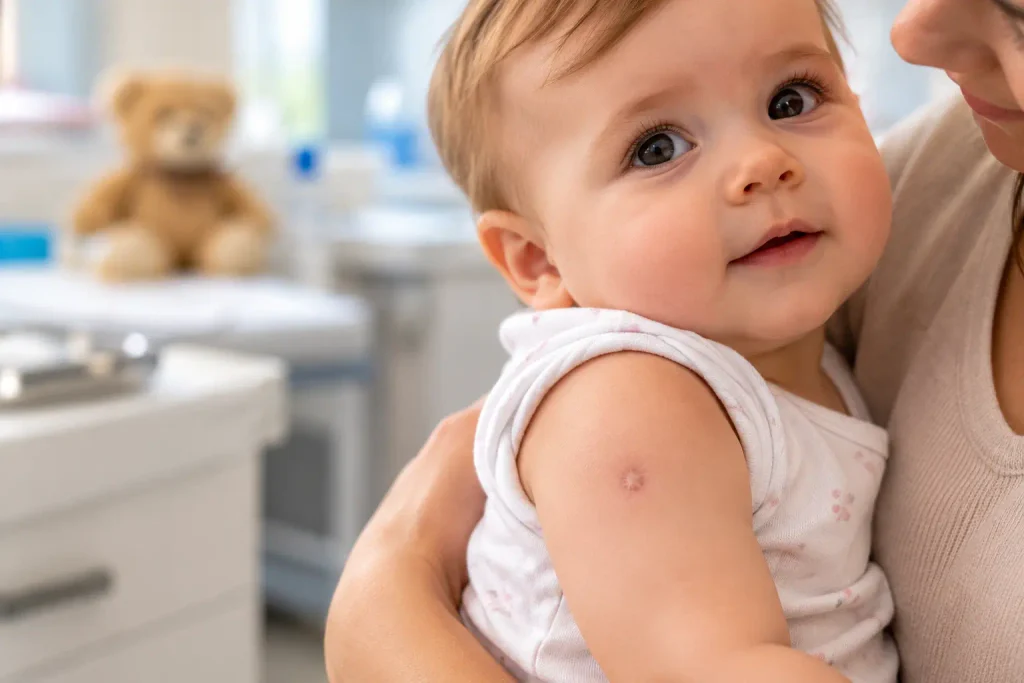
Yes, a small scar is a common result of BCG vaccination. The scar develops as the local reaction heals and can vary in size and appearance. Some children may have a more noticeable mark, while others may have a less obvious scar. The presence or size of the scar should not be used by parents as the only way to determine whether vaccination provided protection. The important point is that BCG vaccination should be recorded in the child’s medical or vaccination record.
Parents should keep this information because previous BCG vaccination can also be relevant when healthcare professionals interpret certain tuberculosis tests.
Can the BCG Vaccine Affect a TB Skin Test?
Yes. One important feature of BCG vaccination is that it can cause a false-positive result on a tuberculin skin test, also known as the TB skin test. This does not mean that the person has tuberculosis simply because the skin test is positive. The CDC explains that previous BCG vaccination can affect the TB skin test, while TB blood tests are not affected in the same way. For people who have received BCG, TB blood tests are generally preferred when appropriate. (CDC) Therefore, anyone who has received BCG should tell their healthcare professional before being evaluated for tuberculosis.
This information helps the clinician choose and interpret the appropriate test.
If you already include preventive habits in your routine, you can also read our article about general health for other practical health topics.
What Are the Common Reactions to BCG?
Most BCG reactions are local and occur around the injection site.
Possible reactions include:
redness or swelling at the injection site
– a small bump that develops after vaccination
– a small ulcer or crust
– a scar after healing
– temporary enlargement of nearby lymph nodes
These reactions can look more dramatic than the small injection mark associated with some other vaccines, which can understandably worry parents. However, a local reaction does not automatically mean that the vaccine has caused a serious problem.
WHO guidance explains that mild injection-site reactions and mild regional lymph node enlargement can occur after BCG vaccination. (WHO)
The safest approach is to observe the area without manipulating it and contact a healthcare professional if the reaction appears unusually severe or the child becomes unwell.
What Are the Rare Complications of the BCG Vaccine?
Serious complications from BCG vaccination are rare. Rare adverse events can include significant lymph node inflammation, abscess formation, osteitis or osteomyelitis, and disseminated BCG infection. The risk of severe complications is particularly important in people with significant immune deficiencies. WHO notes that severe generalized BCG infection occurs primarily in people with HIV infection or severe immune deficiency. (WHO)
Osteitis and osteomyelitis are rare complications involving inflammation or infection of bone. WHO’s vaccine safety information identifies these as rare serious adverse events following BCG vaccination. (WHO) The fact that these complications are recognized does not mean that they are common.
Parents should avoid interpreting a list of possible adverse events as a prediction of what will happen to their child. Vaccines are monitored precisely because uncommon reactions can occur and need to be identified and evaluated.
Who Should Not Receive the BCG Vaccine?

Because BCG is a live attenuated bacterial vaccine, certain medical conditions require special consideration. People with significant immune suppression may be at increased risk of serious complications. The CDC states that BCG should not be given to people who are immunosuppressed, including certain people with HIV infection or those who are likely to become immunocompromised. (CDC)
Pregnancy is another situation in which BCG vaccination is generally avoided unless a specialist determines that vaccination is appropriate because of a particular risk. These recommendations are one reason why vaccination should always take place through an established healthcare system.
A doctor or vaccination professional can consider the child’s medical history, immune status and other relevant circumstances before vaccination.
Does BCG Need to Be Repeated?
Routine BCG revaccination is generally not recommended. WHO guidance states that repeat BCG vaccination has not demonstrated a consistent additional benefit and is not routinely recommended. (WHO) This means parents should not assume that a child needs another BCG dose simply because the scar is small, difficult to see or has faded over time. The vaccination record is much more useful than judging protection by the appearance of the scar.
If there is uncertainty about a child’s vaccination history, the appropriate step is to discuss the record with a healthcare professional.
What Should Parents Watch for After BCG Vaccination?
Parents do not need to constantly check the vaccination site or assume that every small change represents a complication. Instead, observe the child normally and pay attention to symptoms that appear unusual or persistent.
Medical advice should be sought if the child develops a significant or worsening reaction, persistent swelling around a lymph node, an unusual wound that does not heal, persistent fever or symptoms suggesting a more serious problem.
Bone or joint symptoms deserve particular attention if they persist. These can include unexplained swelling, tenderness, restricted movement, limping or avoiding the use of an arm or leg.
Rare complications can sometimes develop later rather than immediately after vaccination, so persistent unusual symptoms should be discussed with a pediatrician.
At the same time, parents should not arrange imaging or specialist investigations simply because a child received BCG and currently feels well.
A healthy child without concerning symptoms does not automatically require special testing after BCG vaccination.
BCG Vaccine and a Healthy Immune System
The BCG vaccine is designed to stimulate an immune response against tuberculosis. It is not a general treatment for every infection and should not be described as a vaccine that makes the immune system universally stronger. A child’s overall health still depends on many everyday factors. Adequate nutrition, regular physical activity, sufficient sleep and appropriate vaccination all contribute to healthy development. You can read more about everyday habits that support normal immune function in our immune system guide.
These habits do not replace vaccination, and vaccination does not replace healthy lifestyle choices.
Instead, they work as different parts of preventive health.
Why BCG Is Still Important Today
Tuberculosis remains a major global health problem. WHO reports that TB continues to affect millions of people worldwide and can be fatal without appropriate treatment. The disease is preventable and curable, but children remain particularly vulnerable to severe forms when infected. (WHO) This explains why BCG remains part of childhood immunization programs in many countries. At the same time, the vaccine is not used in exactly the same way everywhere.
In countries with relatively low TB transmission, BCG may not be part of routine vaccination for every child. The CDC, for example, states that BCG is not generally used in the United States because of the country’s relatively low TB risk and other considerations. (CDC)
Vaccination policy therefore depends on the local burden of tuberculosis and the balance between benefits and risks.
BCG Vaccine Questions Parents Often Ask
Does BCG completely prevent tuberculosis?
No. BCG provides important protection against severe forms of childhood tuberculosis, but it does not guarantee complete protection against every form of TB.
Is a reaction at the injection site normal?
A mild local reaction can be part of the normal response to BCG. The area may change over time and eventually leave a small scar.
Should I remove or cover the BCG scab?
Do not pick or squeeze the area. If you are unsure how to care for the vaccination site, ask your child’s healthcare professional.
Can a child receive BCG more than once?
Routine revaccination is generally not recommended. Follow the vaccination schedule and advice provided by your healthcare authority.
Can BCG cause a positive TB skin test?
Yes. Previous BCG vaccination can cause a positive tuberculin skin test. TB blood tests are not affected in the same way. (CDC)
Are serious BCG complications common?
No. Serious complications are rare, although they can occur, particularly in people with significant immune deficiencies.
Should parents be worried about the BCG scar?
Usually not. A small scar is a common result of BCG vaccination and does not by itself indicate a problem.
Final Thoughts
The BCG vaccine remains an important tool for protecting young children from severe forms of tuberculosis, particularly TB meningitis and disseminated disease. Its greatest benefit is not that it prevents every TB infection, but that it can reduce the risk of dangerous childhood forms of the disease. A local reaction and eventual small scar can be a normal part of the vaccination process. Serious complications are uncommon, but parents should know which unusual or persistent symptoms deserve medical attention.
Most importantly, vaccination decisions should be based on the recommendations of qualified healthcare professionals and the immunization program in the country where the child lives.
BCG is one part of preventive health, alongside appropriate healthy habits, nutrition, sleep, hygiene and timely medical care.
Disclaimer: This article provides general educational information about the BCG vaccine and tuberculosis prevention. It does not replace advice from a pediatrician, doctor or vaccination professional. Vaccination schedules and recommendations can differ between countries and may change as health authorities update their guidance.