


Why Work Messages After Hours Can Keep Your Mind at Work
Work messages after hours can make it difficult to feel that the working day has actually ended. Even when you are physically at home, seeing a new email, message or notification can immediately bring your attention back to unfinished tasks, deadlines or problems that can wait until tomorrow. This does not mean that every message outside working hours is harmful or that you should never respond to an urgent situation. The problem can arise when checking work becomes an automatic habit rather than a conscious choice.
Work-related stress can affect well-being, concentration, sleep and mood, while prolonged occupational stress can contribute to more serious problems over time. The CDC recommends healthy ways of coping with workplace stress, including taking breaks, spending time away from work and doing activities you enjoy outside working hours. (CDC)
Creating a clearer boundary can therefore be a useful part of your mental health routine.
1. Decide When Work Messages After Hours Can Wait
Not every message needs an immediate answer.
Before finishing work, take a few minutes to identify anything genuinely urgent. If there is nothing that requires your attention that evening, give yourself permission to leave the remaining messages until the next working day. This simple decision can reduce the feeling that you need to remain constantly available. For example, if you finish work at 5 p.m., you might decide that routine emails and messages will be reviewed again at 8:30 the next morning. That does not mean ignoring your responsibilities. It means giving ordinary tasks a defined place in your schedule.
If your workplace requires availability outside normal hours, the boundary will naturally look different. In that situation, the goal is not to ignore work but to make expectations around availability as clear as possible.
2. Turn Off Non-Essential Notifications
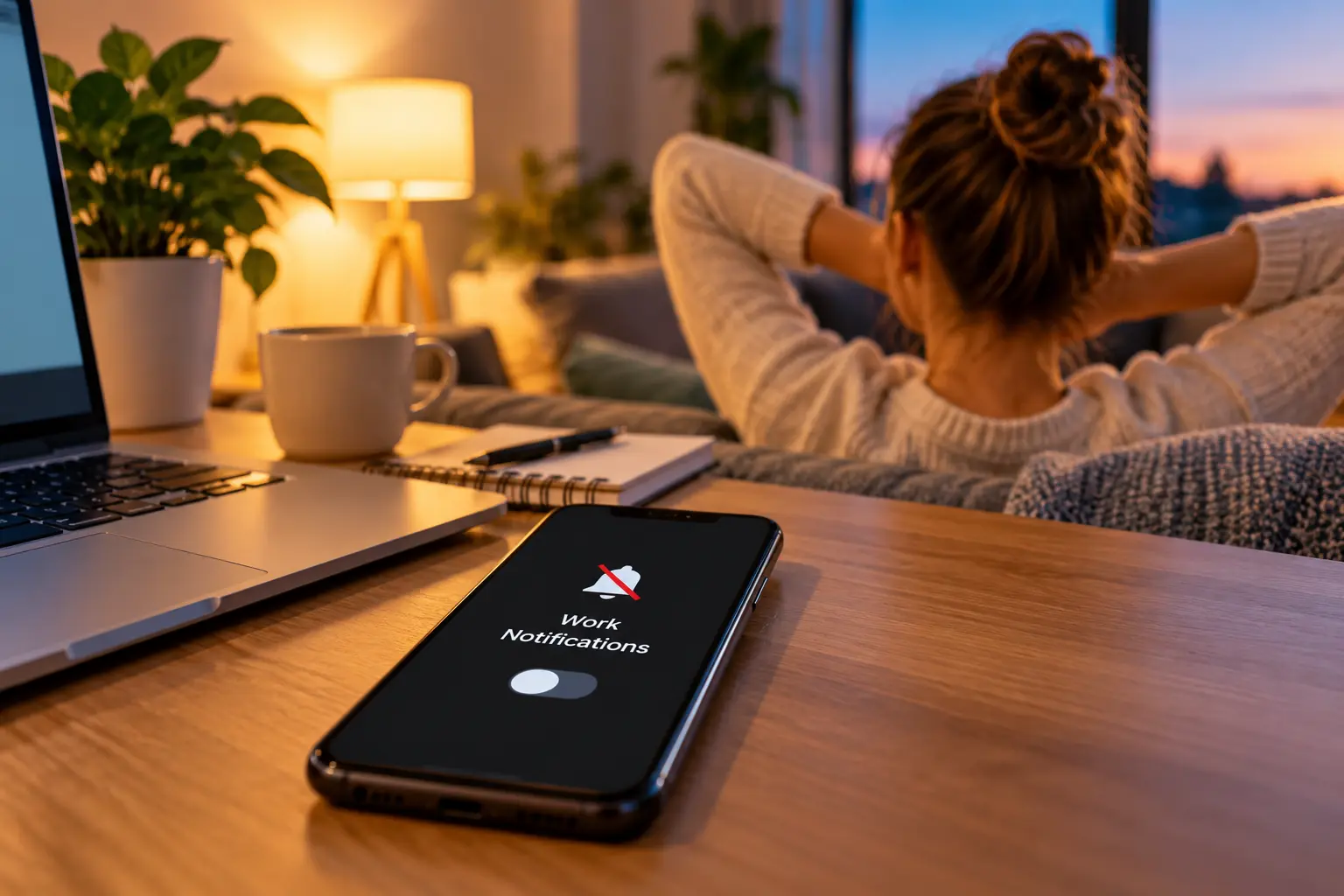
Notifications are designed to attract attention, even when you are doing something completely unrelated to work. A phone vibration while you are having dinner can immediately make you wonder who sent the message and whether something needs to be handled. Even if you do not answer, your attention has already moved away from the activity in front of you. Consider turning off notifications for routine work applications after your working day ends. You can still keep important personal calls or genuinely urgent alerts active.
If your phone allows it, use a separate work profile, scheduled focus mode or notification settings that automatically reduce work alerts during your personal time.
The aim is not to disconnect from the world. It is to remove unnecessary interruptions.
3. Create a Clear End-of-Work Routine
A short transition between work and personal time can help your mind change direction. At the end of the working day, close your laptop, organize tomorrow’s priorities and put work-related items away. If you work from home, physically moving to another room can also help create a stronger separation.
You might finish with three simple actions: check that urgent tasks are covered, write down what needs attention tomorrow and close the work applications. Then move into another activity.
This can be a walk, dinner, time with family, exercise or another activity that has nothing to do with work. If you already use a simple daily routine to manage stress, this transition can become one of its regular parts.
4. Keep Work Messages After Hours Out of Your Evening Routine
Your evening should not become a second working shift simply because your phone is nearby. Imagine sitting down for dinner and checking an email. You read it, think about the answer and perhaps start composing a response in your head. Even if you never open your laptop, part of your attention is still occupied by work. Instead, create a simple rule for routine situations: if a message does not require an immediate response, leave it until the next working period.
This can be especially useful when you are spending time with family or friends. Social connection is another important part of mental well-being, and being mentally present matters as much as being physically present. You can read more about social connection as part of a healthy mental routine.
5. Use a Short Note Instead of Solving the Problem at Night
Sometimes the hardest part is not the message itself but the thought that you might forget something. If a work message reminds you of a task, write down one short note instead of immediately dealing with it.
For example:
Tomorrow: Call the client about the document. That is enough.
You have captured the task without turning your evening into additional work. The next morning, you can review the note and decide what needs to happen. This approach can also help when your mind continues returning to unfinished work. Rather than repeatedly thinking, “I must remember this tomorrow,” you have placed the information somewhere you can find it.
6. Set a Boundary for Work Messages After Hours
A boundary becomes easier to maintain when it is specific. Instead of saying, “I should stop checking work,” choose a clear rule that fits your situation.
For example:
Routine work messages: tomorrow.
Urgent situations: according to your workplace arrangements.
Personal time: no unnecessary work checking.
You can also communicate your normal availability to colleagues when appropriate. You can simply tell colleagues that you will deal with the matter when you are back at work.
Healthy boundaries are not about being unhelpful. They are about making work expectations more predictable. WHO recommends organizational approaches that support mental health at work, including healthy work-life balance, appropriate working arrangements and reducing excessive job strain. (WHO)
When Your Job Requires Availability
Not everyone can completely disconnect after work.
Some jobs involve on-call responsibilities, customer emergencies, management duties or situations where a rapid response is genuinely necessary. In those cases, the solution is not simply to ignore work communication. Instead, try to distinguish between availability and constant checking. If you are officially on call, you can have a system for urgent communication while avoiding unnecessary checking of every routine notification. This can make the boundary clearer and reduce the number of interruptions.
It can also help to discuss expectations with your manager or team. The CDC notes that communication about job stress and identifying workplace factors that contribute to stress can be useful, while WHO emphasizes that workplace conditions and organizational factors have an important role in protecting mental health. (CDC)
A Simple Five-Minute Work Shutdown
You do not need a complicated evening routine. At the end of your working day, spend a few minutes doing the following:
First, check whether anything genuinely urgent remains.
Next, write down the tasks you need to remember tomorrow.
Then, close your work applications and put away your laptop if possible.
After that, silence routine work notifications.
Finally, choose one activity that signals the beginning of your personal time.
You could go for a short walk, prepare dinner, exercise, take a shower or simply sit down with your family. If movement helps you reset after work, your work and wellness routine can provide other practical ideas.
The important part is the transition, not the exact activity.
Work Messages After Hours and Your Evening Mindset
The goal is not to convince yourself that work is unimportant. Work can be meaningful and satisfying, and many people care deeply about doing a good job. The goal is to recognize that your attention also needs time away from work.
When every notification is treated as something that must be handled immediately, the distinction between working time and personal time can gradually disappear. That can make it harder to relax and may leave you feeling as though you are always waiting for the next task. A clearer boundary gives your mind an opportunity to move toward other parts of life.
If you notice that stress continues even after you stop checking your phone, simple techniques such as deep breathing can be another practical part of your routine. CDC guidance on managing stress also recommends making time to unwind, taking breaks, connecting with others and using healthy coping strategies. (CDC)
When Work Stress Is Becoming Too Much
Limiting evening notifications can be helpful, but it is not a complete solution to serious workplace stress.
If you regularly feel overwhelmed, exhausted, anxious, unable to concentrate or unable to recover from work even during your personal time, pay attention to those signs. The CDC lists feeling overwhelmed, tired, lacking motivation, having trouble concentrating and sleep problems among possible effects associated with work-related stress. (CDC)
In such situations, consider talking with someone you trust, your manager or an appropriate workplace support service. If stress is significantly affecting your daily life or mental health, speaking with a qualified mental health professional can provide more individualized support.
The responsibility should not always fall on the individual. Workplace demands, staffing, workload, communication and management practices can also contribute to stress, which is why WHO recommends organizational as well as individual approaches to mental health at work. (WHO)
Frequently Asked Questions About Work Messages After Hours
Should I Never Check Work Messages After Hours?
Not necessarily. If your job requires availability, follow the expectations that apply to your role. The main idea is to avoid checking routine messages automatically when they can safely wait.
What If I Feel Guilty About Not Responding?
Feeling responsible for work can make boundaries difficult at first. Try reminding yourself that delaying a routine response until the next working period is different from ignoring an urgent responsibility.
Should I Turn Off All Work Notifications?
Not always. If you need to remain available for urgent situations, keep the necessary alerts active and silence only routine notifications.
Can This Help With Stress?
Creating a clearer separation between work and personal time may reduce unnecessary interruptions and give you more opportunity to relax. However, persistent or severe stress may require broader changes and professional support.
What Is the Easiest Place to Start?
Start with one rule: routine work messages can wait until the next working day. Once that becomes comfortable, you can build a more complete end-of-work routine around it.
Final Thoughts
Work messages after hours can seem harmless when each individual notification takes only a few seconds. However, repeatedly moving your attention back to work can make it harder to experience a genuine break.
A simple boundary can make a difference. Finish the working day, record anything you need to remember, silence unnecessary notifications and give yourself permission to focus on something outside work.
Your work deserves your attention when you are working. Your personal time deserves your attention when the working day is over.
Disclaimer: This article provides general educational information and is not a substitute for professional mental health advice. If stress, anxiety, low mood or work-related difficulties are persistent or significantly affecting your daily life, consider speaking with a qualified healthcare or mental health professional.